Four Bit Modulo Phase Triplex for Violin, Piano and Cello.
December 2023
Source Material:
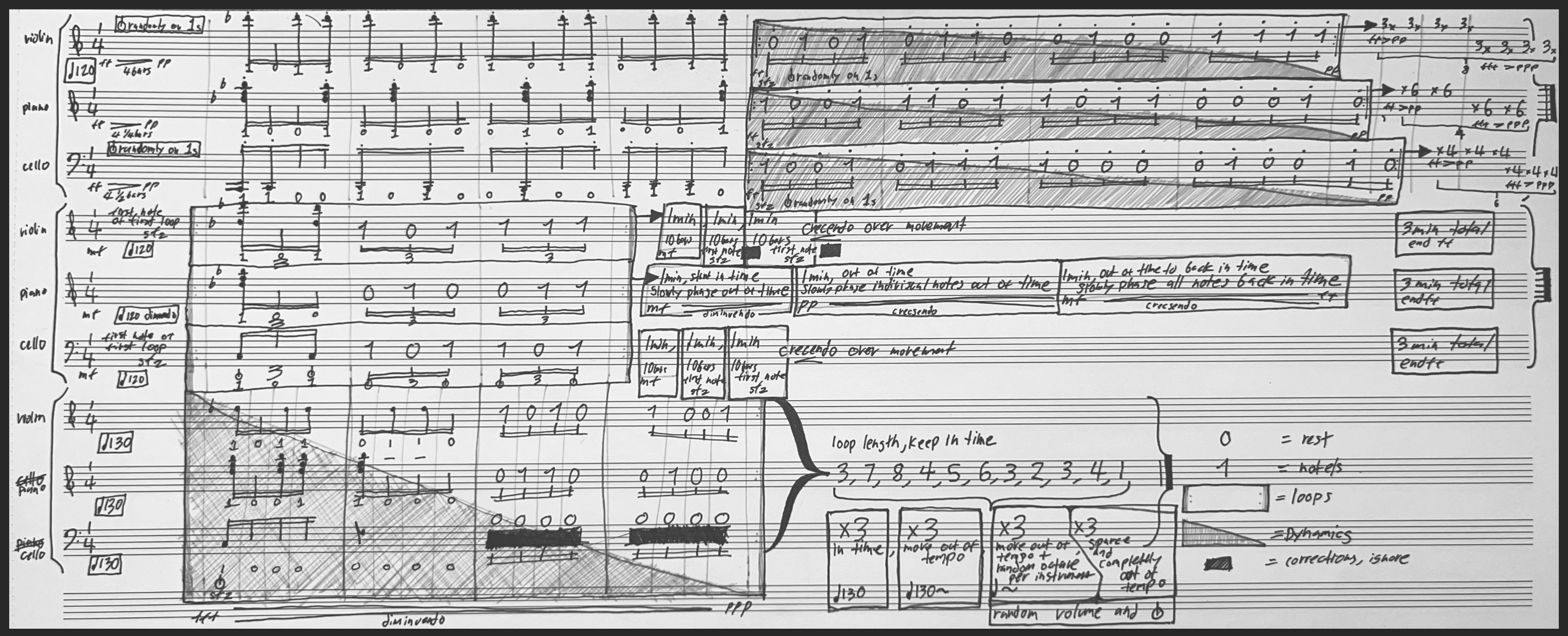
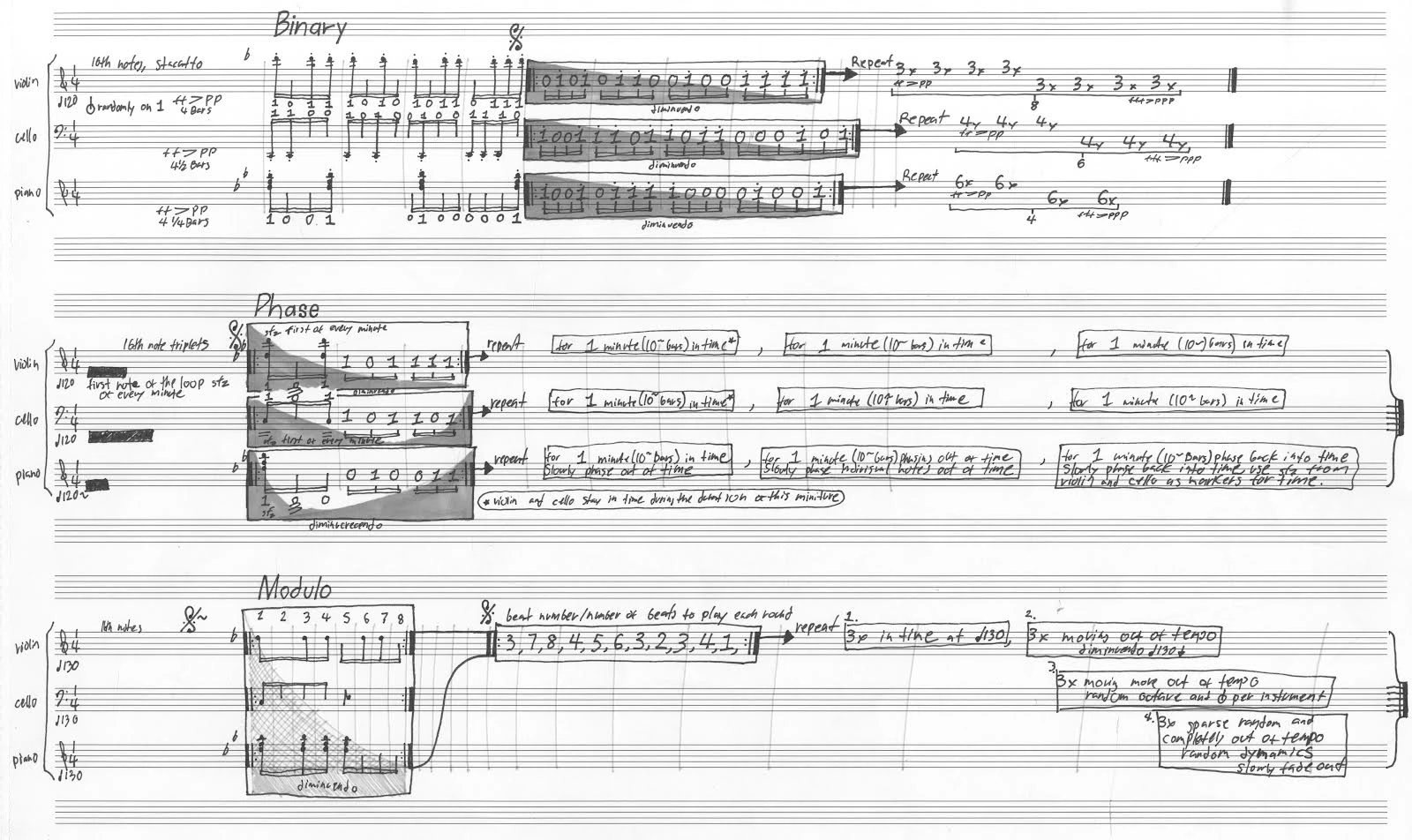
This work is derived from binary data generated by randomly sampling noise from a field recording captured under a highway underpass at 41.814011, -71.406527 (Providence, RI). Each “1” in the score corresponds to the performance of a 16th note or chord, predetermined at the start of the movement. Each “0” represents a rest.
Movement I
Notation and Looping:
The opening 4 bars represent a direct transcription of the binary pattern: “1” = note/chord, “0” = rest.
Violin, piano, and cello subsequently enter into instrument-specific loops of differing lengths:
- Violin: 4-bar loop, repeated 24 times (notated as 8 sets of 3 loops).
- Piano: 4¼-bar loop, repeated 24 times (4 sets of 6 loops).
- Cello: 4½-bar loop, repeated 24 times (6 sections of 4 loops).
Loops may phase against one another due to differing loop lengths; all instruments maintain 16th-note subdivisions at 120 BPM.
Dynamics:
A grey envelope overlay represents dynamic contour.
- Violin loop: First 12 iterations: ff to pp; next 12 iterations: fff to ppp.
- Same rules apply to piano and cello.
Articulation:
- All sounding notes (“1”) are staccato.
- Violin and cello may execute snap pizzicato randomly, preferably at the loop’s onset when the instrument is at a higher dynamic.
Movement II
Tempo:
120 BPM; 16th-note rhythms now performed as triplets. Piano may later deviate in tempo.
Notation:
- New preset pitch material is indicated at the start of each instrument’s loop.
- Snap pizzicatos are now fixed, with spacing considerations to avoid excessive clustering (omit redundant notes if necessary).
- The first note of each loop for violin and cello is marked sfz, serving as a temporal cue for the piano.
Phasing and Temporal Manipulation:
- First ~10 bars (~1 minute): all instruments in strict tempo.
- From ~1:00 onwards, piano gradually phases out: individual notes separate in time, volume decrescendos.
- Approaching the final ~20 seconds, piano phase and tempo reintegrate; crescendo to fff, and all instruments synchronize.
- Violin and cello: continuous crescendo from mf to fff over the course of the 3-minute movement.
Movement III
Tempo:
130 BPM; all notes performed as 16th notes.
Structural Outline:
- Initial section: instruments in strict tempo.
- Subsequent sections: gradual deviations in tempo, pitch (octave displacement), and dynamics, producing aleatoric textures.
- Single cello note at loop onset is sfz.
Looping Scheme:
- Loops vary in length (beats): 3 to 7 to 8 to 4, etc.
- Entire loop sequence is repeated:
- 3 iterations in strict tempo.
- 3 iterations with tempo deviations.
- 3 iterations with deviations in tempo, dynamic, and octave; violin and cello incorporate random pizzicati.
- Final section: disintegration and collapse, allowing rhythmic, pitch, and textural dissolution.
General Performance Notes:
- All instruments adhere to 16th-note subdivisions unless specified.
- Phasing is intrinsic; performers must maintain awareness of loop length and dynamic contour.
- Snap pizzicato, sfz, and staccato articulations are integral for both texture and temporal referencing.
- Dynamics, articulation, and pitch deviations are intentionally flexible in Movements II and III to create evolving, spatialized textures.
This piece is accompanied by a graphic score illustrating the phasing, timing and loop relationships between violin, cello, and piano.